What Is a DAO? Decentralized Organizations Explained
Learn what a DAO is, how token-holder voting actually works, real examples from Uniswap to ConstitutionDAO, and the honest problems with code-run organizations.
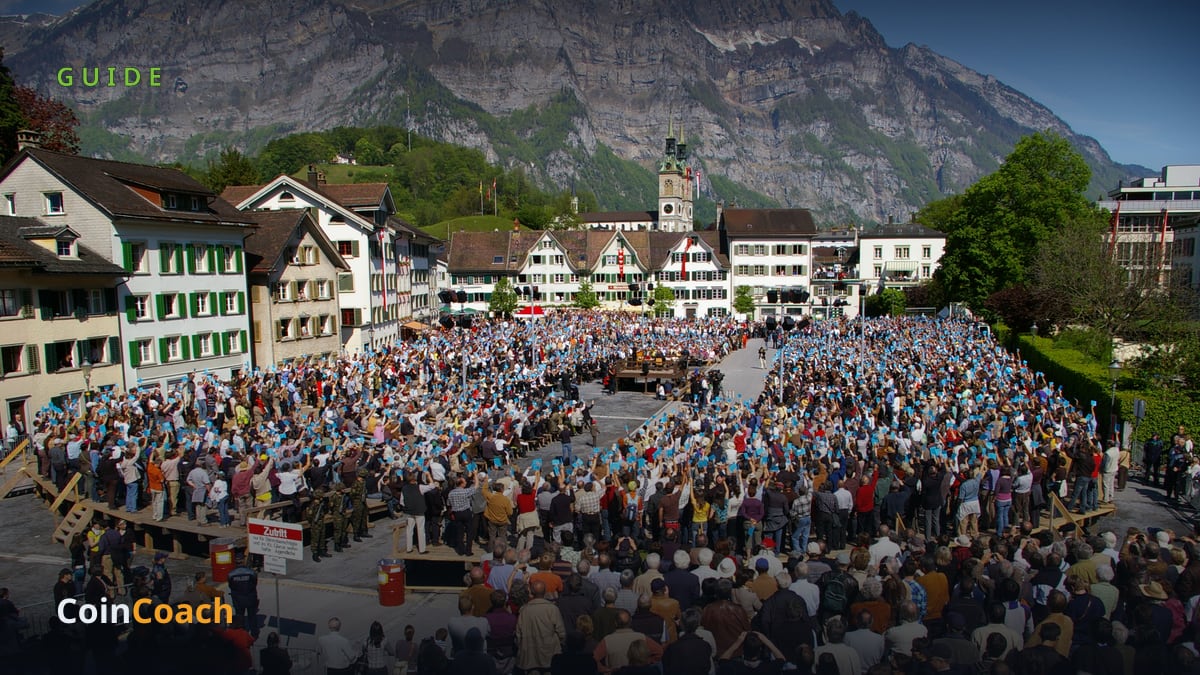
Photo: Marc Schlumpf, www.icarus-design.ch, CC BY-SA 3.0, via Wikimedia Commons
Imagine a club with no president, no board, and no office — just a shared bank account and a rulebook written in code, where every member can vote on how the money gets spent. That is the basic idea behind a DAO — a decentralized autonomous organization, a group whose rules and shared funds live in smart contracts, programs on a blockchain that run automatically and can't be quietly changed by any one person. This guide explains how DAOs actually make decisions, looks at real examples, and covers the problems the marketing brochures skip.
Why DAOs exist
Traditional organizations rely on trusting people: executives who control budgets, lawyers who enforce contracts, banks that hold the money. A DAO tries to replace some of that trust with code. The organization's treasury — its pool of shared funds — sits in a smart contract, and money only moves when members approve it through a vote. Membership usually comes from holding a governance token — a cryptocurrency that works like a voting share, where more tokens generally means more voting power.
How governance actually works
The process at most DAOs follows a similar loop:
- Someone makes a proposal. This can be anything from "spend $50,000 on a marketing campaign" to "change a technical setting in the protocol." Proposals are typically discussed on forums first.
- Token holders vote. Voting runs for a set period, and most DAOs require a quorum — a minimum amount of voting participation for a result to count.
- The result is executed. With on-chain voting, votes are recorded as blockchain transactions and the outcome can trigger automatically — but each vote costs transaction fees. That's why many DAOs use Snapshot, a popular platform for off-chain voting, where members sign free cryptographic messages instead of paying for transactions. Snapshot tallies are not self-executing, so a passing vote still needs someone (often a multi-signature wallet) to carry it out.
Real DAOs, from serious to viral
Protocol DAOs govern real financial systems. Uniswap, the largest decentralized exchange, lets UNI token holders vote on upgrades and treasury spending. MakerDAO — which rebranded as Sky in 2024 — has long used token-holder votes to manage the DAI stablecoin (succeeded in 2026 by its replacement, USDS), setting collateral rules and interest rates for billions of dollars in assets.
The original "The DAO" is the cautionary tale. In 2016, a project literally named The DAO raised around $150 million worth of ether, then the largest crowdfund ever. Weeks later, an attacker exploited a bug in its code and drained 3.6 million ETH — worth more than $50 million at the time. The fallout was so severe that the Ethereum community reversed the theft with a software change in July 2016, splitting the network into today's Ethereum and Ethereum Classic.
ConstitutionDAO was the viral moment. In November 2021, more than 17,000 people pooled about $47 million in ether in under a week to bid on a rare first printing of the U.S. Constitution at Sotheby's. They lost the auction, refunded contributors, and disbanded — but proved a crowd of strangers could organize serious money almost overnight.
The honest problems
- Low turnout. Most token holders never vote, so quorums can be hard to reach and small groups end up steering decisions.
- Whale dominance. Because votes are weighted by tokens, whales — holders with very large balances — can outvote thousands of small members.
- Legal gray zones. Most DAOs have no legal status, which can leave members personally exposed. A few U.S. states have responded: Wyoming passed a law in 2021 letting DAOs register as limited liability companies.
- Slow decisions. Routine choices that a manager would make in minutes can take weeks of forum debate and voting.
- Governance attacks. In April 2022, an attacker used a flash loan — a massive crypto loan borrowed and repaid in a single transaction — to briefly grab 67% of the voting power in the Beanstalk protocol and pass a proposal sending themselves roughly $182 million.
The bottom line
DAOs genuinely shine when strangers across the world need to share a treasury and steer a system no single company should control — decentralized exchanges and lending protocols are the proof. But plenty of projects bolt on a token vote as decoration while insiders keep the real keys. Before joining one, check who holds the tokens, what votes can actually change, and whether anyone shows up to vote at all. This guide is for educational purposes only and is not financial advice.
Sources

CoinCoach publishes clear, trustworthy cryptocurrency and blockchain news, guides, token breakdowns, and reviews.
Related Stories
Bitcoin Halving Cycles: What History Shows and What It Doesn't

CBDCs vs. Crypto: What a Digital Dollar (or Loonie) Would Really Be